Browse
Top articles
How to Meditate: Meditation 101 for Beginners
10 Science-Backed Benefits of Meditation
What is Meditation?
How to Meditate: Meditation 101 for Beginners
10 Science-Backed Benefits of Meditation
What is Meditation?
Benefits of Mindfulness: Mindful Living Can Change Your Life
Mindfulness 101: A Beginner's Guide
Some people call running a form of moving meditation, and for good reason. On the best runs, there’s a sense of flow, where you naturally tune out external distractions and enter a state of relaxed effortlessness, all the while becoming more intimately aware of yourself.
The same is true in meditation.
And when you pair the two, you weave an array of benefits for your mental and emotional well-being into your physical fitness.
Read on to learn how to bring mindfulness along on your next run.
Mindful running is consciously employing the tools of meditation and mindfulness practice to the physical activity of running.
As any runner knows, running can be a naturally meditative endeavor. From the kinetic experience of limbs, muscles, joints, and breath working in sync to the mantra-like rhythm of an efficient stride, on the best runs, you feel effortless, integrated in body and mind, and fully awake in the present moment.
…And then there are those times when running is just a slog: You struggle to find a comfortable pace; your breathing pattern is off; your hip (knee, ankle, fill in the blank) creaks; your thoughts go anywhere but where you actually are. And on it goes until the moment that you realize you’re finally done—and yet can barely recall anything you experienced along the way.
Running with mindfulness means actively engaging your senses and directing your attention to fully immerse yourself in your run, noticing what’s happening inside your body and outside in the environment around you, and meeting it all—effortless stride, creaky knees, and passing scenery alike—with curiosity and acceptance.
The result is a greater feeling of ease and relaxation on your run and a heightened sense of awareness of your body and your environment.
Like mindful walking or any other type of mindful movement, mindful running is an effective way to build your capacity for staying present. And this has far-reaching implications for your mental, emotional, and physical health.
It might even make you a better runner.
Here are some science-backed ways that pairing physical activity like running with mindfulness supports your body and mind:
When you’re under stress, your body moves into a state of high alert. Your muscles tense, your heart rate increases, your blood pressure spikes, and your body releases adrenaline to prepare you to flee or fight. Both running and meditation counter this effect, helping the body come down from a stressed state. Physical movement releases muscle tension and burns off excess energy. Aerobic activity triggers the release of endorphins, which are responsible for what’s known as the “runner’s high.” And following aerobic activity, the body downregulates more quickly into a parasympathetic state that makes you feel more calm and relaxed. Research also finds that those who exercise regularly, like people who practice meditation, may have greater resilience to stressful situations.
Researchers have found that combining aerobic activity, like running, with meditation offers powerful support for people struggling with depression, reducing symptoms by as much as 40 percent.
Research suggests that the combination of aerobic activity and focused attention helps generate new neural cells and keeps them alive. This supports cognitive functions, including learning and memory, and mental and emotional well-being.
Runners who run without external stimulation, such as music, and instead use a mindful focus, report feeling more in tune with their bodies, calmer, and experience a greater sense of control.
One study found that college athletes who did a 5-week mindfulness training showed improvements in both performance endurance and executive functioning. The study authors surmised that by strengthening mindfulness, athletes are better able to ignore external distractions and negative thoughts and can stay mentally connected and more effectively focus on the goal at hand.
When people exercise in nature, they experience a wide range of physical and psychological benefits. The Japanese practice of shinrin-yoku, or forest bathing, has been shown to reduce anxiety, stress, and fatigue and may even boost immunity, among other benefits.
Rick shares the science-backed benefits of mindfulness and how the practice affects the body and brain, and therefore our lives.
Play NowIn this meditation, we'll do a body scan meditation, relaxing bodily tension and grounding ourselves in deep presence.
Play NowSo much of our stress comes from being caught in our thoughts and ideas. In this meditation, we'll drop from our head to our body, the one place that is always present.
Play NowNot necessarily. But pairing mindfulness with running can improve endurance, body awareness, and cognitive function, and these factors might enhance performance.
In a novel experiment, athletic shoemaker Asics tested the role of external psychological factors, including cheering and loud music, against athletes' own internal motivation. The now-famous Blackout Track experiments revealed that athletes ran faster with external stimulation, but they felt calmer, more in control, and more in tune with body and mind when running in a silent and darkened track environment.
Perhaps the easiest focus for meditative running is on the physical training itself—your pace, the swing of your arms, your running form. You can also focus on your breath, particularly the exhalation.
As you feel your focus grow more steady, you might also explore external stimulation, such as noises in your environment, sights, or the sensation of fresh air against your skin.
Whether to breathe through your mouth or through your nose, or a combination of both, while running, is a hot topic in the field of sport science.
Studies have shown that restricting air flow through nasal-only breathing can lead to more efficient lung function and may reduce the risk of exercise-induced asthma. But it is also difficult to maintain, and humans will naturally switch to mouth breathing under exertion.
With mindful running, it might be best to link breath and movement, or what’s called rhythmic breathing. To do it, you start out at a comfortable pace and inhale for a count of 2 or 3, and exhale for the same amount. So, 2-count inhale and then a 2-count exhale. Try inhaling through your nose and exhaling through your mouth. If that feels too challenging, you can inhale and exhale through the mouth, with your focus on the exhalation.
Whether to meditate before or after physical exercise like running is really a personal choice, although there are proponents on either side.
Doing physical exercise before sitting in meditation can help you feel more relaxed and able to hold a steady focus. In the yoga tradition, for example, the physical practice is done before meditation, as a way to warm and loosen the body, to burn excess energy, and to begin to link body and mind in order to tune inward.
Meanwhile, researchers at Rutgers University propose that aerobic exercise done immediately after meditation may be more effective for generating and consolidating neural mechanisms involved with learning and focus and for reducing rumination and distraction.
When you combine running and meditation, you experience the benefits of both on mood, for enhancing concentration and body and mind awareness, and much more.
You often hear people say that running is their meditation, and for good reason. Both running and meditation can make you feel more calm and centered and reduce stress and reactivity.
Running can also trigger a similar flow state that you sometimes experience in meditation. Bringing mindfulness along on your runs is a natural way to make your favorite physical activity a meditative one.
As an aerobic activity, running offers vast physiological benefits and tremendous support for mental and emotional health. Numerous studies have found that running improves mood and outlook and can be a powerful therapeutic tool for people who suffer from depression.
When we run, the body releases endorphins, which, in addition to relieving pain, produce a sense of well-being and calm. Running also stimulates blood flow to the prefrontal cortex, the area of the brain responsible for executive function and mood, and triggers the creation of new brain cells.
Meanwhile, the physical benefits of running—increased cardiovascular capacity, stronger muscles, greater mobility—have positive implications for overall health and your ability to function well in everyday life, which impacts your view of yourself and what’s possible.
Enjoy these articles, stories, and guided practices for incorporating mindfulness into every day.
In Only 15 Minutes a Day
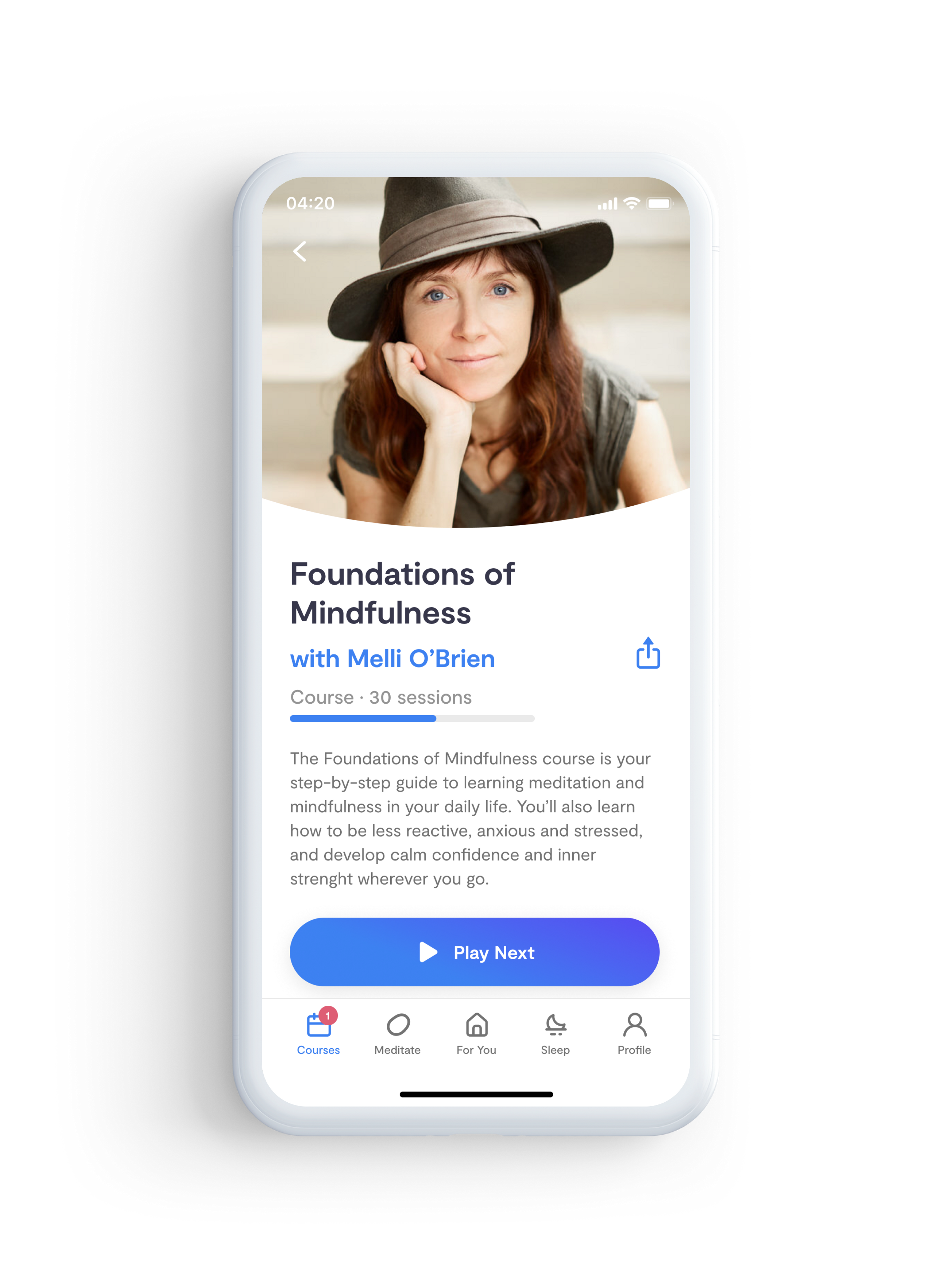
In this 30-day guided course, you’ll learn how to practice meditation and mindful living skills. Along the way, you’ll discover how to become less reactive, ease anxiety and stress, and tap into a core of inner calm and strength to carry with you wherever you go.
Plus
We believe in a world where everybody has access to the life-changing skills of mindfulness.